
8 Time Management Techniques to Make the Most of Your Day
One of the main causes of burnout includes the lack of time we have left for important things outside of the office. Finding work-life balance is a daily struggle. However, contrary to popular belief, time is entirely within our control. Successfully managing time requires reflection and a willingness to change our habits. This leads to improved efficiency and productivity, less stress, and more success in life.
What can you do to get more things done?
How we maximize time is unique to each individual. This means rising early to start the day with a set goal in mind for some people, while others take short breaks throughout the day to refresh and refocus. Ultimately, finding the right time management techniques is a matter of trial and error. The following list is a great starting point for anyone who wants to take control of their day:
Pareto Analysis

Pareto Analysis, also known as the “80/20” rule, states that 80 percent of results come from 20 percent of the work. It is a simple decision-making technique for assessing competing problems and measuring the impact of fixing them. This allows you to focus on solutions that will provide the most returns.
How it works:
- List down the problems you need to resolve.
- Identify the root cause of each problem.
- Score each problem by importance.
- Group problems together by a common cause.
- Add up scores for each group and the top one is your priority.
- It is time to take action.
Best suited for:
- Problem solvers
- Analytical thinkers
Pomodoro Technique

The Pomodoro Technique is a time management system that encourages people to work with the time they have—rather than against it. Using this method, you break your workday into 25-minute chunks separated by five-minute breaks. These intervals are called pomodoros. After about four pomodoros, you take a longer break of about 15 to 20 minutes.
How it works:
- Pick a task that must be done.
- Set a 25-minute timer.
- Work on your task until the time is up.
- Take a 5-minute break.
- Repeat four times.
- Every 4 pomodoros, take a longer 15-20 minute break.
Best suited for:
- Creative thinkers
- Easily burned out
Eisenhower Matrix
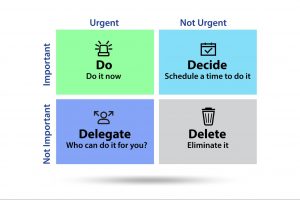
The Eisenhower Matrix identifies that time management is not just about efficiency, but also effectiveness. Otherwise known as the Urgent-Important Matrix, it helps you decide on, and prioritize, tasks by urgency and importance. This can clear enough time to do what’s essential for our success by sorting out less urgent and important tasks, which you should either delegate or not do at all.
How it works:
Categorize tasks into four separate quadrants.
- Quadrant 1 (Do): Urgent and important tasks to be done on the same day.
- Quadrant 2 (Decide): Important but less urgent tasks that can be scheduled.
- Quadrant 3 (Delegate): What’s urgent, but less important, delegate to others.
- Quadrant 4 (Delete): Neither urgent nor important, don’t do it at all.
Best suited for:
- People in leadership positions
- Critical thinkers
Parkinson’s Law
Parkinson’s Law is the idea that work expands to fill the time available for its completion. If you procrastinate and complete the task right before the due date, it will be more difficult and daunting to accomplish.
How it works:
Technically, this is not a time management technique. It’s a law. When understood, it can be a method to work more efficiently in shorter bursts of time.
- Work on your laptop without using the charger to force you to finish a task.
- Start on a project earlier than you are used to.
- Set a deadline for yourself and cut it in half.
Best suited for:
- Procrastinators
- People who work well under pressure
Time Blocking Method

Time blocking is a method of scheduling in advance a set number of hours for each task or responsibility during a day. You divide your day into blocks of time with each block dedicated to accomplishing a specific task, or group of tasks, instead of keeping an open-ended to-do list.
How it works:
- Write down each hour of the day and allocate blocks of time, such as half-hour or hour chunks.
- Estimate and specify the time required for each time to fit them in your time blocks.
- Include buffer time in between blocks for adjustments in your day.
Best suited for:
- Working students or parents
- Analytical thinkers
Rapid Planning Method (RPM)
More than a time management technique, Rapid Planning Method is a system that will help you increase your productivity. The acronym RPM also stands for results, purpose, and massive action. This is a way of thinking to condition your brain by focusing on the outcome and result that you’re after.
How it works:
- Instead of a usual to-do list, capture everything that you need to do in a day and organize them by commonalities.
- Create an RPM Plan with 3 critical questions: what do I really want (results-focused), why does it matter to me (purpose-driven), and how will I achieve it (massive action)?
- Commit to a schedule and work on your tasks. Aside from completing them, look for how you can leverage your work as much as possible.
Best suited for:
- Working students or parents
- People who have long-term goals
Pickle Jar Theory

The pickle jar theory is based on the idea that time, like a pickle jar, time is limited. The jar represents your life and its contents with a limited volume of space. This prioritizes your daily activities while respecting the time estimate for each. It gives you time to spare instead of too few hours in the day.
How it works:
Imagine a jar filled with sand (small, less important tasks), pebbles (tasks with average importance), and rocks (big, important tasks). To plan your day, start with an empty pickle jar:
- Put 3-4 large rocks inside.
- Add in a handful of pebbles and jiggle them to make them fit.
- Next, scoop some sand and fill the remaining space with water.
The wisdom in this is not in the items placed but in the order. If you began with sand and water, followed by the pebbles, you wouldn’t have enough room for the rocks. Thus, your day ends up being unproductive.
Best suited for:
- Visual people
- Concrete thinkers
Eat That Frog Technique
The gist of the “Eat that frog” is to identify one important task for the day and to do it first. Tackling “the frog” in the morning takes advantage of how productive you are for the day. This channels your best self to the task with the highest value before the less important but more urgent matters get in the way.
How it works:
- Identify your frog or the hardest task for the day. Just one!
- Eat the frog by doing it first thing in the morning. Do not set it aside for later.
- Repeat every day and you’ll notice how small steps prompt bigger accomplishments.
Best suited for:
- Abstract thinkers
- People with long-term goals
Setting Yourself Up For Success
At the end of the day, there is no one-shoe-fits-all time management technique. It is how you constantly reevaluate yourself and put everything into practice. Don’t just visualize the outcome. Make every minute count. The hurdle to change is the first step and taking action is another. Everything else will follow. By managing your time, you set achievable goals, strive for excellence, break bad habits, and gain more personal growth. Failure starts when you make unnecessary pursuits, and the next thing you know, you’ll wish you could turn back time.
Practice these time-saving techniques at work today or use them when applying for a new job on Mynimo.com.